
Satellite television has become an important part of everyday entertainment, giving viewers access to hundreds of channels from different countries and broadcasting networks. However, keeping these channels available often requires following frequency updates and making occasional adjustments to receiver settings.
When a channel disappears, the signal becomes unstable, or a new broadcast is introduced, knowing the correct technical information can save a great deal of time. Proper tuning allows the receiver to locate the desired channel while maintaining better signal quality and viewing stability.
In this article, we provide useful information about satellite broadcasting, channel reception, frequency changes, and receiver configuration, with practical guidance designed to make the tuning process easier for both beginners and experienced users.
The Eutelsat 16°E satellite position is an important European orbital location carrying a wide range of tv, radio and transmit services. For viewers in the United Kingdom, receiving Eutelsat 16°E requires careful satellite antenna positioning, suitable equipment and a sharp line of sight.
Because Eutelsat 16°E is located between other popular European satellite positions, accurate positioning is especially important. Even a small error in the antenna direction, elevation or LNB position can cause the antenna to lock onto a nearby satellite instead.
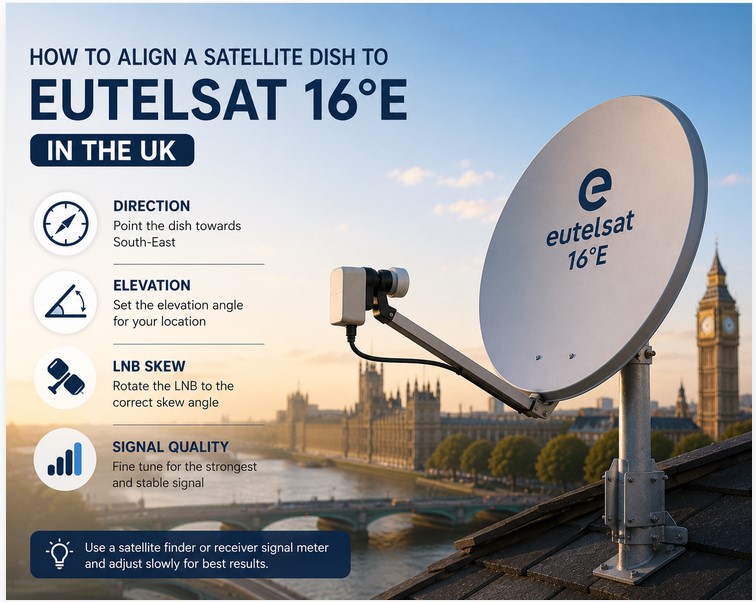
This guide explains how to align a satellite antenna to Eutelsat 16°E in the UK, from preparing the configuration to fine-tuning the transmission.
Choose the Right Location for the Satellite Dish
The first step is choosing a suitable place to setup your satellite antenna.
From the UK, Eutelsat 16°E generally appears in the south-eastern part of the sky. The antenna needs a sharp line of sight in that direction.
Before configuration, check for obstacles such as:
- Tall structures.
- Trees and branches.
- Chimneys.
- Walls.
- Roof structures.
- Nearby houses.
- Large metal objects.
Even a relatively small obstacle can weaken the satellite transmission. Trees are particularly important because branches can move during strong winds or grow into the transmission path over time.
Make Sure the Mounting Pole Is Perfectly Vertical
A perfectly vertical mounting pole is essential for accurate satellite antenna positioning.
Before adjusting the antenna, use a spirit level to check the pole from multiple sides.
If the pole is not vertical, the elevation markings on the antenna bracket may not provide accurate results. This can make it much more difficult to locate Eutelsat 16°E.
A correctly installed mounting pole makes it easier to:
- Set the elevation accurately.
- Adjust the antenna direction.
- Find the satellite more quickly.
- Fine-tune the transmission.
- Maintain steady reception.
Understand the Direction of Eutelsat 16°E from the UK
Eutelsat 16°E is located at 16 degrees east, but this does not mean that the satellite antenna should point directly east.
From most locations in the United Kingdom, the satellite is generally located toward the south-east.
The exact azimuth depends on your location.
For example, the antenna direction will vary between:
- London.
- Birmingham.
- Manchester.
- Liverpool.
- Cardiff.
- Glasgow.
- Edinburgh.
- Belfast.
For accurate positioning, it is best to use a satellite positioning calculator or a reliable satellite finder application that can calculate the exact azimuth and elevation for your configuration location.
Set the Correct Elevation Angle
The elevation angle determines how high the antenna points above the horizon.
The correct elevation for Eutelsat 16°E varies across the UK.
As you move farther north, the satellite generally appears lower in the sky. This means the required elevation can be various in southern England compared with Scotland or northern areas.
To set the elevation:
- Loosen the elevation adjustment bolts slightly.
- Use the elevation scale on the antenna bracket as a starting point.
- Set the approximate elevation for your location.
- Move the antenna slowly upward or downward.
- Monitor the transmission clarity reading.
Make very small movements and wait for the device to refresh the transmission meter.
Configure Your Receiver Before Searching
Before searching for Eutelsat 16°E, check that your satellite device is configured correctly.
Typical settings may include:
- Satellite: Eutelsat 16°E
- LNB Type: Universal
- LNB Frequency: According to the specifications of your LNB
- DiSEqC: Configured correctly if multiple LNBs are being used
If your antenna receives more than one satellite, make sure Eutelsat 16°E is assigned to the correct DiSEqC port.
Incorrect device settings can prevent successful reception even if the antenna is correctly aligned.
Move the Dish Slowly to Search for the Signal
After setting the approximate direction and elevation, begin searching for the satellite transmission.
Move the antenna very slowly from left to right.
A useful method is to:
- Move the antenna a small distance.
- Wait for several seconds.
- Check the transmission clarity.
- Continue moving gradually.
- Stop when the transmission appears.
Do not move the antenna too quickly.
Satellite receivers may take several seconds to refresh the transmission meter. Fast movements can cause you to pass the correct satellite position without noticing it.
When a transmission appears, stop and begin making smaller adjustments.
Focus on Signal Quality
Most satellite receivers display both:
- Signal Strength
- Signal Quality
Signal strength alone does not confirm that the antenna is pointing at the correct satellite.
Because several satellite positions are relatively close to Eutelsat 16°E, you may receive a strong transmission from another nearby orbital position.
For accurate positioning, focus mainly on transmission clarity.
The correct antenna position should provide the highest steady transmission clarity for the selected Eutelsat 16°E service or transponder.
Adjust the LNB Skew
The LNB skew is the rotation angle of the LNB inside its holder.
The correct LNB skew depends on your location in the UK.
After finding Eutelsat 16°E:
- Loosen the LNB holder slightly.
- Rotate the LNB slowly.
- Monitor the transmission clarity.
- Make small adjustments.
- Stop at the best transmission reading.
- Secure the LNB firmly.
A small adjustment to the LNB position can sometimes produce a noticeable improvement in transmission clarity.
Confirm That You Have Found Eutelsat 16°E
After receiving a strong transmission, do not immediately assume that you have found the correct satellite.
Eutelsat 16°E is located between other satellite positions, so confirmation is important.
You can verify the satellite by:
- Performing a channel search.
- Checking the detected services.
- Confirming the satellite name on the device.
- Verifying a known active service or transponder.
If unexpected channels appear, the antenna may be pointing at another satellite.
In this situation, return to the positioning process and make very small adjustments to the antenna direction.
Fine-Tune the Dish for the Strongest Signal
Once you have confirmed the correct satellite, fine-tune the configuration.
Make small adjustments to:
- Dish direction.
- Elevation.
- LNB skew.
Change one setting at a time and watch the transmission clarity.
If moving the antenna slightly in one direction improves the transmission, continue until the clarity begins to fall. Then return to the strongest position.
The goal is to achieve the highest steady transmission clarity rather than simply finding any transmission.
Tighten the Dish Carefully
Once the best transmission has been found, tighten all mounting bolts gradually.
Avoid tightening one bolt completely before checking the others.
The antenna can move slightly while the bolts are being tightened, so check the transmission clarity throughout the process.
After the antenna is fully secured:
- Check the transmission clarity again.
- Confirm that the transmission remains steady.
- Check the LNB connection.
- Inspect the wire.
- Perform a channel search.
If the transmission remains strong after the bolts have been tightened, the positioning is complete.
Common Problems When Aligning Eutelsat 16°E
No Signal
If no transmission appears, check:
- The satellite wire connections.
- The condition of the LNB.
- The antenna direction.
- The elevation angle.
- The device settings.
- The DiSEqC configuration.
- The mounting pole.
- Possible obstacles in the transmission path.
Strong Signal but Wrong Channels
A strong transmission with unexpected channels may mean that the antenna is pointing at another nearby satellite.
Confirm the satellite using the device’s channel search or known active services.
Then make small horizontal adjustments until the correct satellite is found.
Weak or Unstable Signal
A weak transmission may be caused by:
- Slightly incorrect antenna positioning.
- Incorrect elevation.
- Poor LNB skew.
- A damaged LNB.
- Low-clarity or damaged wire.
- Loose connectors.
- Water entering outdoor connections.
- Trees or structures blocking the transmission.
- Poor weather conditions.
Fine-tuning the antenna can often improve reception.
Can Eutelsat 16°E Be Combined with Other Satellites?
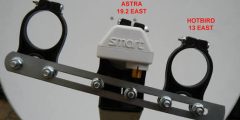
Yes, depending on your antenna size and configuration setup, Eutelsat 16°E may be combined with other satellite positions using multiple LNBs.
A multi-satellite setup can allow reception from several nearby orbital positions without using a separate antenna for each satellite.
The success of this type of configuration depends on:
- Dish size.
- Your location.
- Accurate positioning.
- LNB holder design.
- Signal strength.
- DiSEqC settings.
It is usually best to align the main satellite accurately before installing additional LNBs.
Can Weather Affect Eutelsat 16°E Reception?
Heavy rain, snow and strong winds can affect satellite reception.
A properly aligned antenna provides a better transmission margin and can improve stability during poor weather.
If the antenna is only receiving a weak transmission, heavy rain may cause picture freezing or temporary transmission loss.
For this reason, fine-tuning the antenna for the highest possible transmission clarity is important.
Tips for a Strong and Stable Eutelsat 16°E Signal
For the best reception, follow these recommendations:
- Choose a location with a sharp line of sight.
- Make sure the mounting pole is perfectly vertical.
- Use a good-clarity LNB.
- Install high-clarity satellite wire.
- Protect outdoor connections from water.
- Avoid unnecessary wire joins.
- Move the antenna slowly during positioning.
- Focus on transmission clarity.
- Adjust the LNB skew carefully.
- Recheck the transmission after tightening the antenna.
How Weather Affects Satellite Reception
- Heavy rain can temporarily weaken satellite signals, particularly at higher frequencies.
- Strong winds may shift a poorly secured dish and reduce alignment accuracy.
- Moisture, dust, and ice can also affect exposed satellite components.
- A correctly aligned dish and weather-resistant equipment can improve reception stability.